

Extended Linear Peptide Synthesis
Up to 150 Amino Acids
Advanced solid-phase peptide synthesis delivering complex linear sequences without the need for native chemical ligation.

Introduction
Amide Technologies’ Automated Fast Flow Peptide Synthesis (AFPS) enables routine production of extended linear peptides up to 150 amino acid residues. Born from groundbreaking research at MIT’s Pentelute Lab with key early stage input from Jensen Lab, our technology was developed in response to a simple provocation: “Why can’t chemical peptide synthesis be as good as the ribosome?”
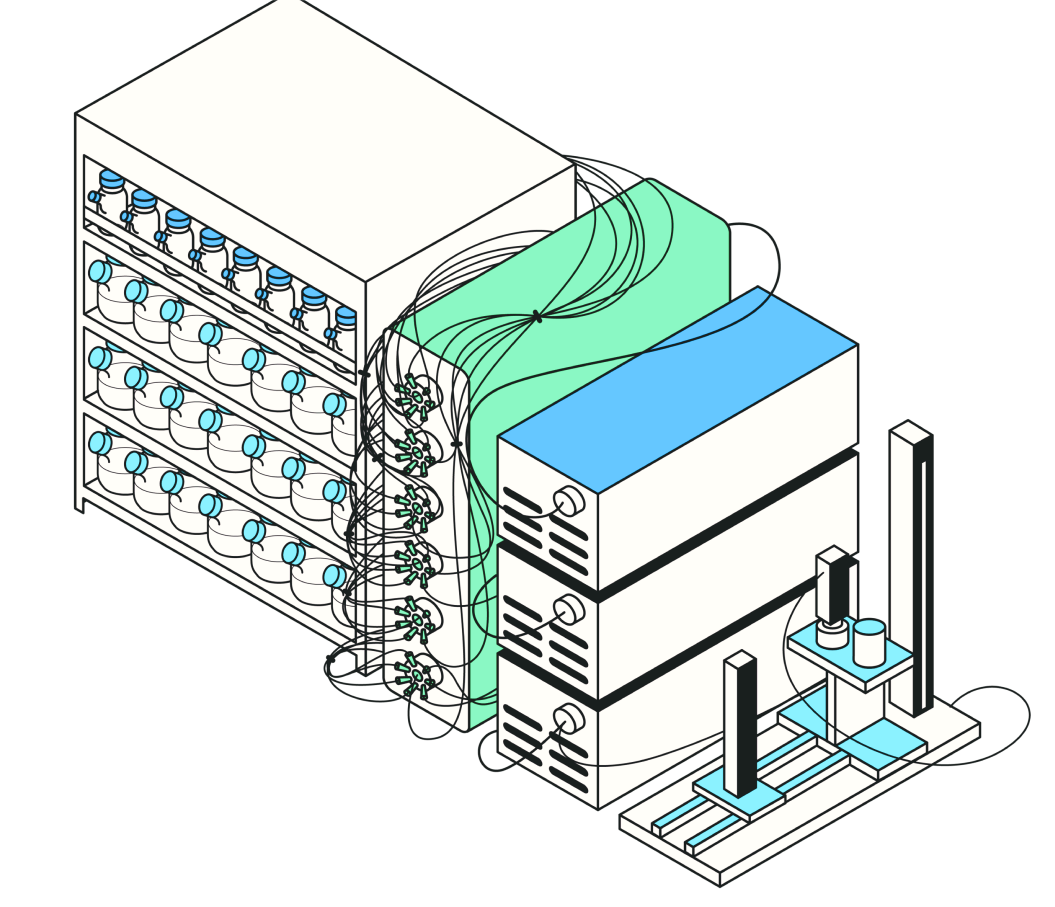
Our AFPS platform leverages flow to dramatically improve solid-phase peptide synthesis. Using the power of flow, we generate highly reactive intermediates in situ, maintain excellent heat and mass transfer, and achieve synthetic outcomes that surpass alternative SPPS methods. This means that for the first time, you have routine access to challenging extended linear peptides that traditional batch synthesis struggles to produce consistently.
Unlike fragment condensation approaches requiring native chemical ligation (NCL), Amide’s continuous linear synthesis methodology produces peptides in a single synthesis run, eliminating the complexity of fragment junction points and reducing the risk of side products or misfolded sequences. With Amide, you no longer have to wonder “how am I going to get my peptides?”
Why Choose Amide’s Linear Synthesis for Extended Peptides?
Single-Chain Integrity
Our linear AFPS approach synthesizes your peptide as one continuous chain from C-terminus to N-terminus, preserving sequence integrity without introducing ligation sites that could complicate downstream applications.
Superior Synthesis Speed
Using heat and flow, our AFPS method dramatically accelerates synthesis cycles while maintaining high coupling efficiency, delivering your extended peptides faster than traditional batch methods.
Enhanced Reliability
The flow-based approach provides consistent heat and mass transfer throughout the synthesis, enabling reliable production of complex peptides that traditional methods struggle with—including highly hydrophobic sequences and aggregation-prone constructs.
Simplified Purification
Without NCL junction points, you avoid the complexity of desulfurization reactions and intermediate purification steps, resulting in cleaner final products and faster turnaround times.
Sequence Flexibility
Linear synthesis accommodates virtually any amino acid sequence, including difficult sequences with multiple prolines, beta-branched residues, or aggregation-prone regions that can challenge fragment-based methods. Novel structures enable novel modalities, which means more effective clinical programs supported by Amide’s synthesis.
MIT-Proven Technology
Our foundational technology was developed at MIT specifically to close the gap between chemistry and biology, bringing ribosome-quality synthesis to chemical peptide production.
Technical Capabilities
Length Range: 1-160 amino acid residues
Synthesis Scale:
- Research scale: 1-10 mg
- Standard Reactor Scale: 10-50 mg
- Large Reactor Scale: 50-300 mg
- 300+ mg available upon request
Purity Specifications:
- High Quality Crudes
- Basic purity: >85% (HPLC)
- Standard purity: >90% (HPLC)
- High purity: >95% (HPLC)
Modifications Supported:
- N-terminal modifications (acetylation, biotinylation, fluorescent labels, click chemistry, lipidation, and more) –
- C-terminal modifications (amidation (CONH2, non-canonical amines), esterification, click chemistry)
- Side-chain modifications (acetylation, lipidation, biotinylation, fluorescent labels, click chemistry, phosphorylation, methylation)
- Disulfide bridge formation (air oxidation or directed)
- Other cyclizations (lactam, N to C, Lactone, stapled)
- D-amino acids, non-natural amino acids, and isotopic labeling
Quality Assurance:
- HPLC analysis (analytical)
- Mass spectrometry (ESI-MS or MALDI-TOF)
- Trifluoroacetic acid removal and/or quantification
- Full documentation package with synthesis reports
Our Synthesis Methodology
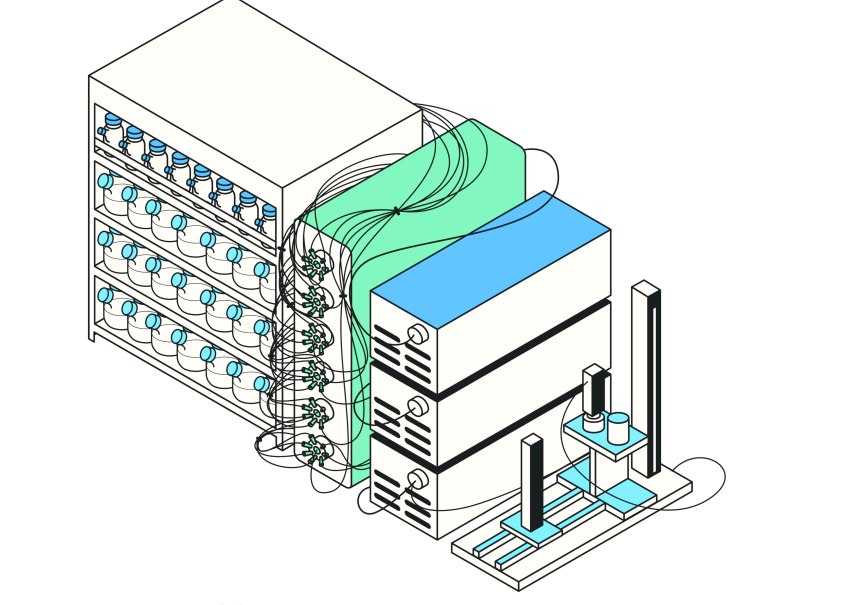
Amide’s Automated Fast Flow Peptide Synthesis (AFPS) represents a fundamental advancement in solid-phase peptide synthesis, specifically optimized for extended linear sequences. Our flow-based approach enables consistent success with challenging long peptides that traditional batch methods cannot reliably produce.
Flow Chemistry Advantages: By leveraging flow, we generate highly reactive intermediates in situ and maintain excellent heat and mass transfer throughout the synthesis. This results in superior coupling efficiency and minimal deletion sequences, even in difficult peptide regions.
Heat-Accelerated Synthesis: Our platform uses controlled heating to dramatically accelerate coupling reactions while maintaining fidelity, reducing synthesis time without compromising quality.
Optimized Resin Selection: We carefully select resin type and loading based on your peptide’s specific characteristics, balancing reactivity with stability to minimize aggregation and deletion sequences.
Enhanced Coupling Chemistry: Our AFPS protocols achieve >99.5% coupling efficiency even in sterically hindered regions and highly hydrophobic sequences that challenge traditional methods.
Aggregation Management: For sequences prone to on-resin aggregation—common in extended peptides—the continuous flow environment prevents peptide chain collapse, maintaining accessibility throughout synthesis. We also employ specialized solvents, chaotropic additives, and pseudoproline dipeptides when needed.
Real-Time Monitoring: We use advanced spectrophotometric monitoring integrated with our flow system to verify coupling completion at each step, with immediate corrective action if coupling efficiency drops.
Optimized Cleavage and Deprotection: Our cleavage cocktails are customized for your peptide’s amino acid composition, protecting sensitive residues while ensuring complete deprotection of side chains.
Applications
Amide’s linear peptide synthesis service supports diverse research and development applications across multiple fields. With AFPS, biopharma pioneers can dramatically re-think what’s possible—novel structures enable novel modalities, which means more effective clinical programs.
Therapeutic Development: Peptide drug candidates, receptor agonists and antagonists, antimicrobial peptides, cell-penetrating peptides, immunogenic epitopes, and next-generation peptide therapeutics requiring extended sequences.
Structural Biology: Protein domains for NMR or crystallography studies, peptide antigens for antibody production, competitive inhibitors, and protein-protein interaction probes.
Chemical Biology: Peptide substrates for enzymatic assays, protease-resistant analogs, FRET-based reporters, and molecular scaffolds for drug conjugation.
Vaccine Research: Multi-epitope constructs, peptide immunogens, and adjuvant-conjugated sequences.
Novel Modalities: Extended linear peptides as scaffolds for innovative therapeutic approaches, including peptide-drug conjugates, multi-specific constructs, and macrocyclic precursors.
Handling Difficult Sequences
Extended linear peptides often present synthetic challenges including aggregation, slow coupling kinetics, and deletion sequences. Amide’s AFPS technology was specifically designed to overcome these obstacles that limit traditional batch synthesis.
Highly Hydrophobic Peptides: For the first time, customers have routine access to highly hydrophobic peptides. Our flow-based system prevents on-resin aggregation through continuous solvent flow and optimized thermal management, enabling synthesis of sequences that are simply not feasible with conventional methods.
Beta-Branched and Proline-Rich Sequences: Sequences rich in beta-branched amino acids (Val, Ile, Thr) or containing multiple consecutive prolines benefit from AFPS’s heat-accelerated coupling and in situ generation of highly reactive intermediates, achieving complete coupling where traditional methods fail.
Aspartimide Prevention: For aspartimide-prone sequences containing Asp-Gly or Asp-Ser motifs, we employ protecting group strategies and optimized deprotection conditions to minimize cyclization side reactions.
The power of flow allows Amide to broaden your horizons with better, faster synthesis of peptides previously considered too difficult for reliable production.
Quality Control and Documentation
Every synthesized peptide undergoes comprehensive analytical characterization before delivery. You receive detailed documentation including synthesis protocols, analytical HPLC chromatograms showing purity profile, mass spectrometry confirming molecular weight, and handling and storage recommendations.
For peptides requiring ultra-high purity (>95%), we perform multiple rounds of preparative HPLC with fraction analysis to ensure your final product meets specifications.
Timeline and Ordering
High Quality Crudes (70-90% pure under 30 mers): in less than one week Standard Turnaround: 2-3 weeks from sequence confirmation Expedited Service: 1-2 weeks (available for select sequences) Complex Sequences: 3-8 weeks (sequences requiring extensive optimization)
To request a quote or discuss your peptide synthesis needs, contact our technical team with your target sequence, desired scale, purity requirements, and any modifications. Our scientists will review your sequence and provide a detailed proposal including feasibility assessment, timeline, and pricing.
FREQUENTLY ASKED QUESTIONS
Why not use native chemical ligation for peptides over 100 residues?
While NCL is powerful for very long peptides (>200 residues), Amide’s linear AFPS synthesis for peptides up to 160 residues offers significant advantages including simpler purification, no ligation site constraints, faster timelines, and superior reliability. NCL requires cysteine residues at ligation junctions and additional desulfurization steps if non-cysteine sequences are desired, adding complexity and potential for side reactions. Our flow-based approach enables single-chain synthesis with consistently high coupling efficiency throughout the entire sequence.
What makes Amide's AFPS different from traditional batch synthesis?
AFPS leverages flow chemistry to generate highly reactive intermediates in situ and maintain excellent heat and mass transfer throughout synthesis. This allows us to routinely produce highly hydrophobic peptides, complex sequences, and extended linear peptides that traditional batch methods cannot reliably synthesize. With all these advantages, AFPS allows biopharma pioneers to dramatically re-think what’s possible.
What is your success rate with peptides in the 120-150 residue range?
Our success rate for peptides in this range exceeds 85%, significantly higher than traditional batch synthesis methods. Occasionally these sequences take longer and may require more optimization. The continuous flow environment and heat-accelerated coupling of our AFPS platform enable reliable production of extended peptides that would be considered extremely challenging or impossible with conventional approaches.
Can you synthesize cyclic peptides in this length range?
Yes, for the first time, customers have routine access to cyclic constructs in extended length ranges. We can perform both head-to-tail cyclization and side-chain-to-side-chain or side-chain-to-backbone cyclization for extended linear peptides. Cyclization strategies are evaluated based on your specific sequence requirements.
What if my peptide contains non-natural amino acids?
We routinely incorporate a wide range of non-natural amino acids including D-amino acids, N-methyl amino acids, fluorinated residues, beta-amino acids, and various side-chain modified residues. Our AFPS platform’s flexibility accommodates diverse building blocks. Availability and coupling efficiency vary by amino acid; consult with our team for specific requirements.
How do you handle peptides that form disulfide bonds?
For peptides requiring disulfide bonds, we can perform air oxidation for simple single-disulfide peptides or directed disulfide formation using orthogonal protecting groups for complex multi-disulfide structures. Proper folding is confirmed by analytical methods including mass spectrometry and HPLC.
Get Started
Ready to discuss your extended linear peptide synthesis project? Our technical team is available to review your sequence, provide feasibility assessments, and design an optimized synthesis strategy tailored to your specific needs.
Contact us today for a no-obligation quote and technical consultation.